Warning: This article is rooted in the principles of Ayurveda and is intended for informational purposes only. It is not a substitute for professional medical advice, diagnosis, or treatment. Before making any changes to your diet or lifestyle, especially if you have a chronic condition, please consult your healthcare provider or a certified nutrition specialist.
Yoga and Ayurveda are often called sister sciences. Both view the human being as a holistic system containing material matter in the form of the physical body as well as subtle structures, invisible to the eye yet quite applicable to life. Ayurveda has a strong focus on worldly life; its recommendations are less ascetic than those of yoga, and it offers an approach that is universal and accessible to everyone. Yoga also offers various practices for working with the body, e.g. cleansing (shatkarmas), but its primary focus is working with the mind. Far from everyone is ready to practice yoga, even though a concise manual called “Ashtanga Yoga,” first described in the sutras of Patanjali, has existed for many centuries.
History and overview of Patanjali’s Yoga Sutras
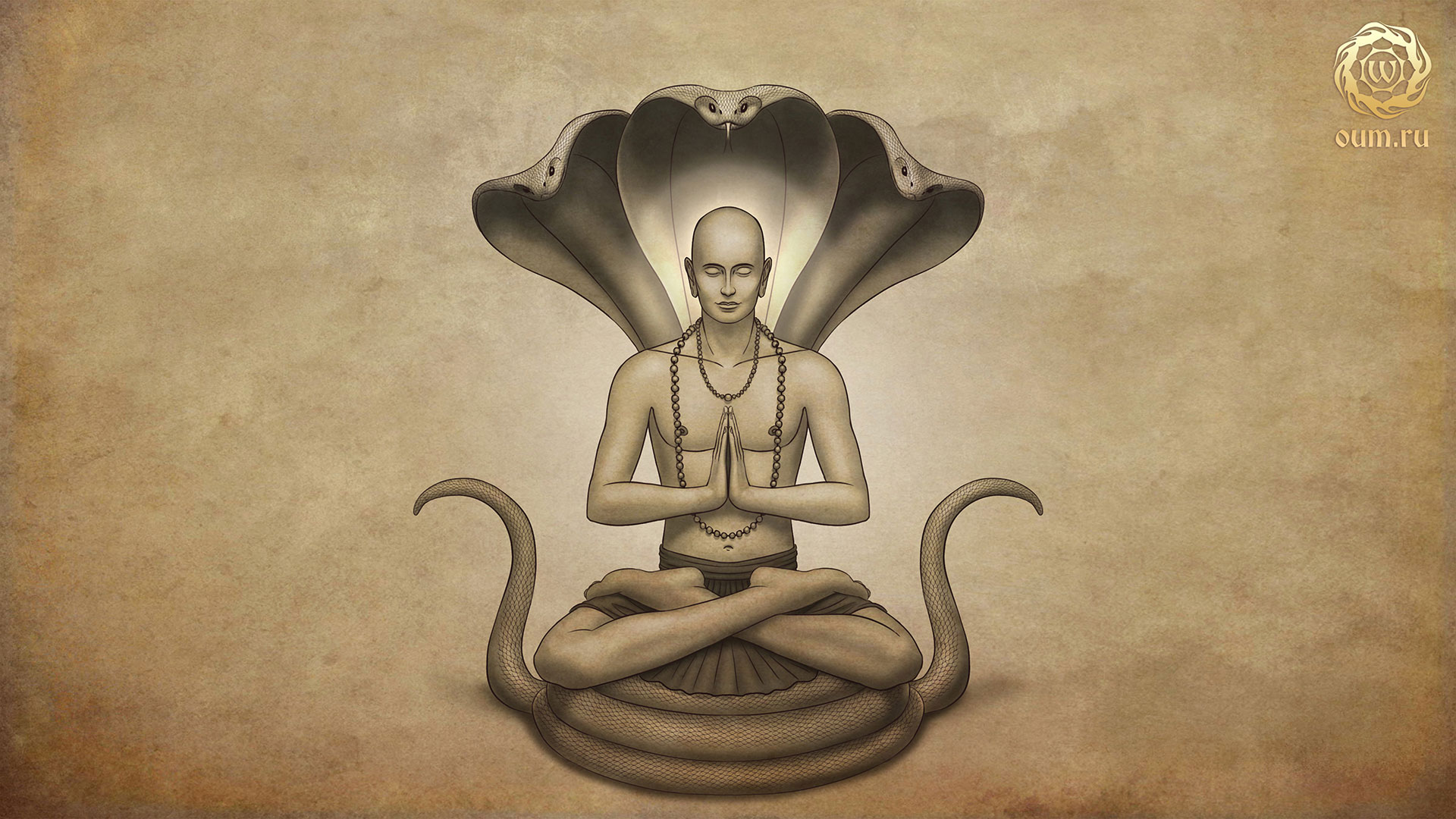
While the exact date of the Yoga Sutras’ creation remains unknown, these ancient scriptures are believed to have originated between 500 and 200 BCE. The yogi Patanjali, about whom very little is known, is considered the author of the sutras. The only fact we know for sure is his advanced level of practice, for only a realized practitioner could have provided such a coherent system of knowledge and practical recommendations. His name, Patanjali, is often translated as “he who fell into the palms of one’s hands during prayer.” Consequently, there is a legend that Patanjali fell from the sky in the form of a snake; this tale inspired many illustrations of the yogi, in which he is often depicted as a man with a snake’s tail instead of legs.
Patanjali’s work is written in the form of sutras— a common way of presenting information across various fields of knowledge in ancient India. Sutras are distinguished by their brevity, clarity, and richness. Literally, “sutra” translates as ‘thread, rope, or that which binds.’ This refers to the connection between teacher, teachings, and student, since knowledge was passed down orally from student to teacher in ancient times. Today, many works have come down to us in book form— this provides tremendous opportunities for spiritual development and self-improvement.
The four chapters of Patanjali’s Yoga Sutras are as follows:
- Samadhi Pada — the chapter on samadhi. It explains the essence of yoga, describes the problems that arise along the practitioner’s path, and offers solutions to these problems.
- Sadhana Pada — the chapter devoted to qualities necessary for shifting the mind from a distracted state to a focused one.
- Vibhuti Pada — the chapter about the abilities of a mind that, through various techniques, can reach a state of liberation from all distractions.
- Kaivalya Pada — the chapter describing the abilities of a person with a supremely pure mind.
Patanjali’s Yoga Sutras are a must-read for anyone who aspires to follow the path of yoga. They contain priceless, profound knowledge, from simple rules for making everyday decisions to advanced techniques for working with the mind. The Yoga Sutras can be difficult to understand upon first read, especially if studied without explanation, but many editions have valuable commentaries from yoga masters. These explanations will help you grasp the essence of the concepts and maintain your interest in yoga.

The eight limbs of yoga
Patanjali’s yoga consists of eight steps, each of which is important and independent. The description of these steps begins in the second chapter and continues into the third, where the 6th, 7th, and 8th limbs are described in more detail. The first two are comparable to commandments in religions.
The eight limbs of yoga represent a transition from external interactions to a subtle state of introspection. The given order of the limbs should not be viewed as a strict system of practice; everyone must follow an individual path, one that is unique to themself. As the practitioner progresses, development will occur in all eight limbs of yoga.
Patanjali’s yoga is also called Ashtanga yoga (“ashta” means ‘eight’), eight-part yoga, or eight-petaled yoga.
The eight limbs, according to Patanjali:
- Yama — restrictive rules or things that should not be done. These are very specific actions meant to be avoided. In other words, this is how we relate to our surroundings.
Yama includes five rules or limitations:
- Ahimsa — literally, ‘non-violence’ or non-harming. It refers to a considerate attitude toward all living beings, not only humans. Helping those in need, especially those who are innocent, in difficult situations, or worse off than ourselves is a good idea. Pushing ourselves to extremes to help the entire world is not advisable, especially when it is unasked for. But when faced with a problem, one should choose non-violence whenever possible. The most obvious example is switching to vegetarianism, an ethical diet. It’s also important to remember that the principle of non-violence must be applied to oneself: one must eat right, get adequate rest, choose a virtuous environment, etc.
- Satya — truthfulness, or trying not to lie or deceive. In general, this rule concerns ethical communication through speech or writing and implies honesty, both to others and oneself.
- Asteya — non-stealing, or not taking what doesn’t belong to you. This recommendation applies both physically and mentally: it’s important not to covet what belongs to others, not to envy, and not to succumb to greed.
- Brahmacharya — chastity, abstinence from excessive pleasures, and moderation in all things. Pleasures on the physical plane come through the senses and organs of action; it is important to control this process, avoiding misuse or overuse of these organs.
- Aparigraha — non-covetousness. This principle includes maintaining non-attachment to everything, showing contentment with what one has, limiting hoarding and materialism, and showing modesty in one’s demands.
- Niyama are recommended actions, a sort of individual discipline.
Niyama also includes five rules:
- Saucha — purity. It implies maintaining cleanliness on the physical level (body and environment) as well as purity of thoughts.
- Santosha — contentment. This is the ability to take joy in what one has, including the given circumstances (without complaining or grieving).
- Tapas — asceticism. Self-limitation in pleasures and self-discipline in practice help eliminate impurities in the body, developing the body and senses.
- Svadhyaya — self-knowledge, self-development. It refers to studying one’s personal strengths and weaknesses, thus transforming oneself in a positive way. For instance, this can be done by reading holy scriptures.
- Ishvara Pranidhara — devotion to God. Worshipping God and dedicating all actions and merits to Him is an integral part of yoga.
It’s important to remember that Yama and Niyama must be observed on all three levels: body, speech, and mind.
- Asana — a comfortable position. Today, asanas in yoga are primarily viewed as physical exercises for maintaining health, flexibility, strength, and endurance. The Yoga Sutras define an asana as a stable and comfortable body position, specifically for further, longer breathing practices and work with the subtle structures of the human body.
- Pranayama — the process of controlling prana (breathing) and increasing energy through various breathing techniques. Pranayama also involves a transition from unconscious breathing to its more conscious form.
- Pratyahara — control of the senses. It is a state in which the practitioner disconnects the senses from eternal objects, and these senses (sight, smell, taste, sound, touch) no longer distract them.
- Dharana — concentration. This is a state of mind in which attention can be directed toward a chosen object despite the presence of many others. Concentration can be performed on many objects: one’s breath, the sound of a singing bowl, a flame, icons (depictions of holy objects or people), etc.
- Dhyana — contemplation, meditation. Prolonged concentration (Dharana) on an object leads to a state of meditation in which the movement of the mind forms a continuous flow, connected only to the object of the practice.
- Samadhi — merging, absorption, integration. It is a state of complete fusion (merging) with the object without self-awareness, also described as a kind of loss of individuality. Ultimately, Samadhi is attaining a state of superconsciousness.
It’s impossible to comprehend Patanjali’s work after just one reading. Long, thoughtful study — and, most importantly, regular conscientious and good-natured practice — will help achieve results!
Bibliography:
- T. K. V. Desikachar. “The Heart of Yoga: Developing a Personal Practice.”
- ”The Yoga Sutras of Patanjali. 11 Synchronous Translations.”
The views expressed are based on traditional Ayurvedic texts and do not constitute medical advice.