Warning: This article is rooted in the principles of Ayurveda and is intended for informational purposes only. It is not a substitute for professional medical advice, diagnosis, or treatment. Before making any changes to your diet or lifestyle, especially if you have a chronic condition, please consult your healthcare provider or a certified nutrition specialist.
Prakriti is the prime substance of the original form of everything. It is the source of all the energies of the material world. In Ayurvedic teachings, Prakriti determines physical and psychological traits of an individual, as well as its character and personality.
Prakriti is the innate balance and the constitutional type of an individual. Ayurveda underlines the importance of preventive care, maintenaning good health through proper thinking, diet and lifestyle, and places great emphasis on maintaining the balance.
Ayurveda helps an individual to understand how to create the balance of body, mind and consciousness according to its own nature or Prakriti, and how to change one's lifestyle to remove the cause of imbalance and maintain harmony. Knowing its Prakriti can help a person achieve unity and harmony with oneself and the world around.
What is Prakriti in Indian philosophy?
Prakriti (Sanskrit. प्रकृति, prakṛti) means‘nature’in Sanskrit, and literally Pra-kriti (कृति, kṛti — action, activity, and creation; प्र, pra, means forward and outward directions, as well as intensification, originality and primordiality) — ‘original action’, ‘original movement’, ‘first creation’.
prakṛtiḥ śarīrasvarūpam
Prakriti is the individual unique structure of the body constitution.
Ashtanga-hridaya-samhita, Sutrasthana, 1.10
In Sankhya philosophy Prakriti is the initial, eternal, omnipresent, unborn, or rather self-born substance. It is not only the origin of physical, but also of emotional and mental forms.
Prakriti manifests itself in eight aspects: Avyakta (unmanifested, undisclosed, undifferentiated), Mahana (intellect), Ahamkara (Ego), and the five primal elements of being, Tanmatras (hearing, touch, sight, taste, and smell).
In yoga philosophy Prakriti is interpreted as the opposite of Purusha (i.e., Consciousness, Supreme Spirit). However, they are always in unity that gives birth to the material world. As well as Prakriti, Purusha is the cause, the origin of all things in the universe.Together they form the natural order of the universe, the so-called cosmic law that regulates the existence of everything.
Before the creation of the world, Prakriti was inseparably united with Purusha. At the moment of creation there was a differentiation, but they remained united with the Eternal like fire and heat, always being one and the same.
As stated in the‘Devibhagavata-purana’, Prakriti is the form of five goddesses: Durga, Lakshmi, Saravati, Savitri and Radha. Prakriti, being the essence of Shakti, the root cause and the mother of all things, is the progeny of Shiva and Ishvara.
Purusha is the hidden, invisible being, while Prakriti is the manifested world, which cannot exist without Purusha.
Prakriti: doshas and gunas. Types of Prakriti
According to Ayurveda, Prakriti is formed at the moment of conception with a special combination of doshas and gunas, which determines not only physical, but also psychological and mental traits. There are two types of Prakriti: physical (Sharira-Prakriti) and mental (Manasika-Prakriti).
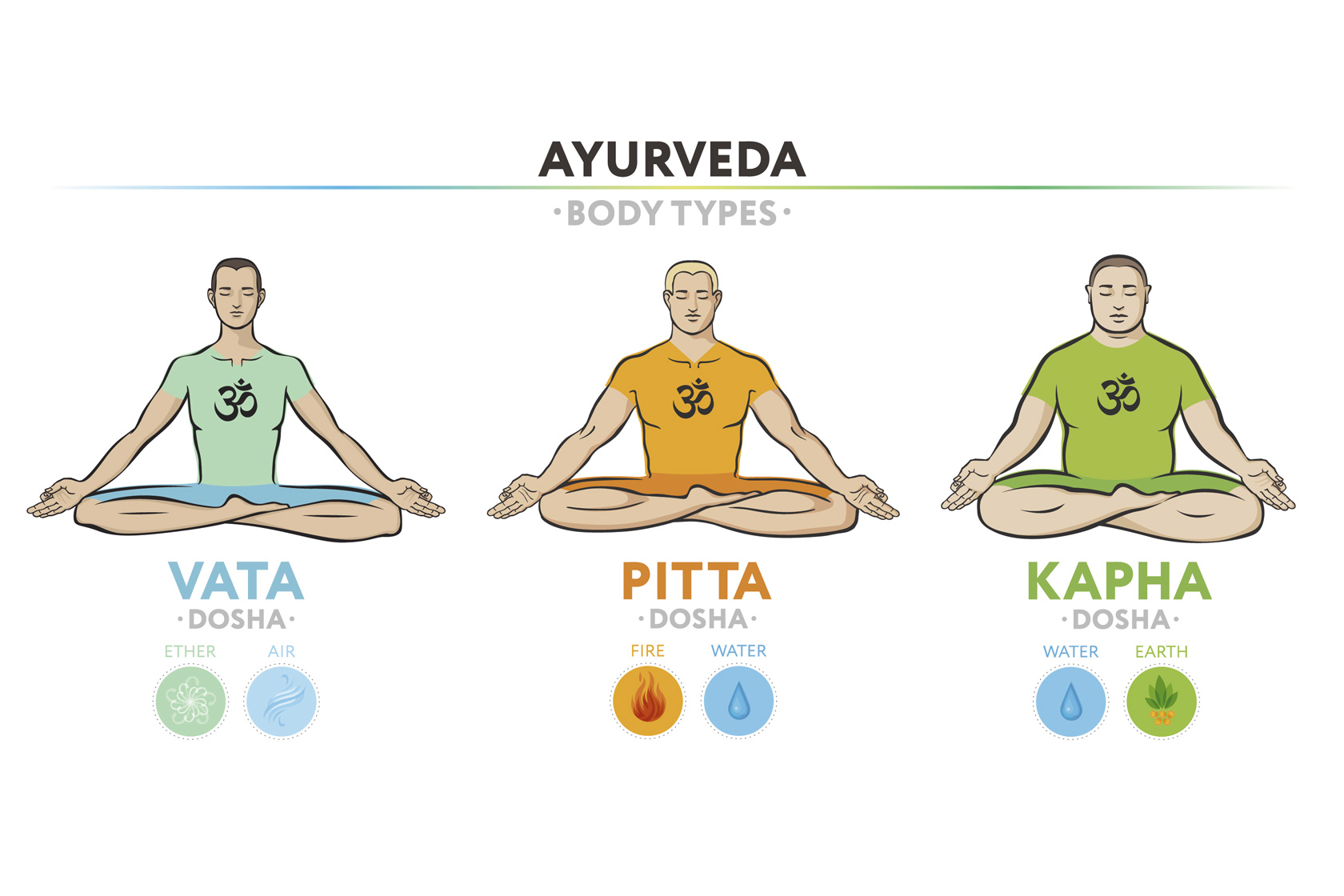
Physical Prakriti is usually determined by doshas. Ayurveda identifies three main types of energies that are present in the entire universe and in every being.
These energies are known as doshas and defined as Vata, Pitta, and Kapha. Prakriti depends on the proportion in which the doshas are distributed and which one is predominant. It doesn’t mean that it is in excess, but rather that there is a deficiency of the other doshas.
The physical Prakriti is divided into seven subtypes: Vata, Pitta, Kapha, Vata-Pitta, Pitta-Kapha, Kapha-Vata and Tridosha. All people possess the qualities of the three doshas, but one is usually predominant, the second is less manifested, and the third is usually the weakest. Single dosha constitutions are very rare.
Combinations with equal amounts of the two doshas are most common. This is called Dvidosha-Prakriti, i.e., dual Prakriti, e.g., Vata-Pitta, Kapha-Vata or Pitta-Kapha. There is also a constitution with equal amounts of all three doshas called Tridosha-Prakriti.
Prakriti doshas cannot be in excess or deficiency, therefore, they do not cause diseases. Prakriti doshas support life and do no harm, their combination defines our nature, which is determined from birth.
While Sharira-Prakriti is influenced by the ratio of doshas, Manasika-Prakriti (the psychological constitution of an individual) depends on the ratio of gunas in one's nature.
Prakriti manifests itself differently in every being depending on the proportions of three gunas. There are three kinds of the psychological Prakriti based on emotional, mental, and behavioural qualities: Sattvika, Rajasika and Tamasika.
Sattva, Rajas and Tamas are transformations of the nature of Prakriti. Therefore, Prakriti determines the psychosomatic constitution of an individual as its innate nature.
Just as all matter is made up of the five elements, so is our body. Their ratio is influenced not only by the food we eat, but also by the activities to which we devote our time. This also has an impact the ratio of three gunas and doshas, given to us at birth.
The five elements are present in the doshas in the following combinations: Vata is the energy of space and air, Pitta is mader up of fire and water, and Kapha dosha is a combination of earth and water. Each possess a certain combination of gunas: Sattva, Rajas and Tamas.
The ether element or Akasha is prevailing in Sattva, wind, or Vayu in Rajas, and the earth element of Prithivi in Tamas. Fire (Agni) is dominant in Sattva and Rajas. Water (Jala) is predominant in Sattva and Tamas.
When doshas are in balance, they demonstrate the following qualities: light and unpredictable, impetuous Vata energy in balance boosts creativity and flexibility; fiery and intelligent Pitta promotes understanding, intelligence and caring; earthy, measured and steady Kapha energy in balance is expressed as love, calmness, forgiveness, generosity, foresight, righteousness, nobility and modesty.
Prakriti and Vikriti. Vikriti is a state of imbalance
While Prakriti is a unique and healthy constitution of an individual, Vikriti is a temporary state of a person at a certain point in time, which represents some kind of deviation from the norm (Prakriti).
According to Ayurvedic teachings, diseases are caused by imbalance in body. However, knowing our Prakriti, we have an idea of the propensities for certain diseases and, accordingly, we can prevent the occurrence of Vikriti by taking prophylactic measures, which in Ayurveda are called Panchakarma.

Panchakarma is a method of purifying the body, mind, and consciousness and it includes specific recommendations on physical exercises, daily routine, and nutrition based on an individual’s Prakriti. The choice of nutrition should be in harmony with the needs of Prakriti, which will help to maintain the human body in a healthy state.
Balance can be disturbed by external influences, as well as by our own incorrect attitude towards our nature. The degree of deviation of Vikriti from Prakriti indicates the seriousness of diseases caused by this imbalance.
An example of Vicriti is an elevated body temperature relative to the normal level, 36.6o C is considered normal, at which one is healthy. However, baseline body temperature can vary from one individual to another.
An increase in temperature is a state of Vikriti. The greater the difference between the norm (Prakriti) and the deviation from it (Vikriti), the stronger the imbalance, indicating disease.
Ayurveda doesn’t focus on diseases. According to this ancient teaching, our whole life should be kept in equilibrium through the balance of energies. Ayurveda recognises the uniqueness of each living being and the special approach that it requires. Unlike Western medicine that tends to take a general approach, Ayurveda addresses all aspects of existence: body, mind and spirit.
Therefore, Ayurveda helps resolve Vikriti in the most harmonious and sensible way, unlike the radical aggressive methods of modern Western medicine.
Vikriti doshas
Vikriti is a condition of the body that leads to diseases. In Ayurveda, diseases can be caused by an excess or deficiency of one of three doshas: Vata, Pitta, or Kapha. In the physical body, Vata is the subtle energy of movement, Pitta is the energy of digestion and metabolism, and Kapha is the energy that governs the structure of the body.
Accordingly, an imbalance in one of the doshas leads to disturbances in the interaction of energies and functional failures in our body and mental state. Vata controls breathing, heartbeat, and the movement of muscles and tissues. If unbalanced, it creates fear and anxiety.
Pitta is expressed through the metabolic system of the body. It governs digestion, nutrition, metabolism and body temperature. Unbalanced Pitta aroses anger, hatred, and jealousy.
Kapha energy forms the structure of the body (i.e., bones, muscles, tendons), holds cells together, provides the body with water that lubricates the joints and moisturises the skin. If unbalanced, Kapha leads to attachment, greed, and envy.
Vikriti doshas are ‘malas’ clogging the bodily channels, causing depression, fatigue and weakness. They appear already at the prenatal stage of development and affect the body throughout life.
Many factors affect the balance of doshas, be it the time of year or day, the period of life or the stage of digestion, they can cause either an excess or a depletion of certain energies in the body. If there is a significant increase in a particular dosha, it can lead to illness.
How to identify one's Prakriti?
A significant deviation from the natural state of an individual (Prakriti) makes its body more susceptible to illness.
According to Ayurveda, it’s necessary to identify one’s Prakriti in order to be able to recognise deviations from the normal condition and determine the needs to restore the balance and get rid of diseases resulting from disruption of the natural balance of energies.
You can identify your Prakriti by taking a special test on our website. With its help you will find out your natural constitution. It is important to know your Prakriti in order to understand yourself better and live a healthy and harmonious life.
The views expressed are based on traditional Ayurvedic texts and do not constitute medical advice.